


Bus Terminal
Port Authority, New York, New York
2026
This design for a new Port Authority Bus Terminal in New York City draws inspiration from the great Beaux-Arts masterpieces that were built in New York City around the turn of the last century, including the original Penn Station and Madison Square Garden, as well as Grand Central Terminal. This design for a new Port Authority Bus Terminal builds upon that architectural heritage and seeks to once again make that style and transportation architecture in general great again.
Port Authority is the main bus terminal in Manhattan. It is currently being replaced in real life as the need is very much there for an updated structure. This alternative traditional design, while meeting all of the functional needs, would also uplift and beautify New York City as well as establish a paradigm within the United States for future projects. This design is meant to re-inspire America and give hope that we can dream big again and be proud of our cities and nation.
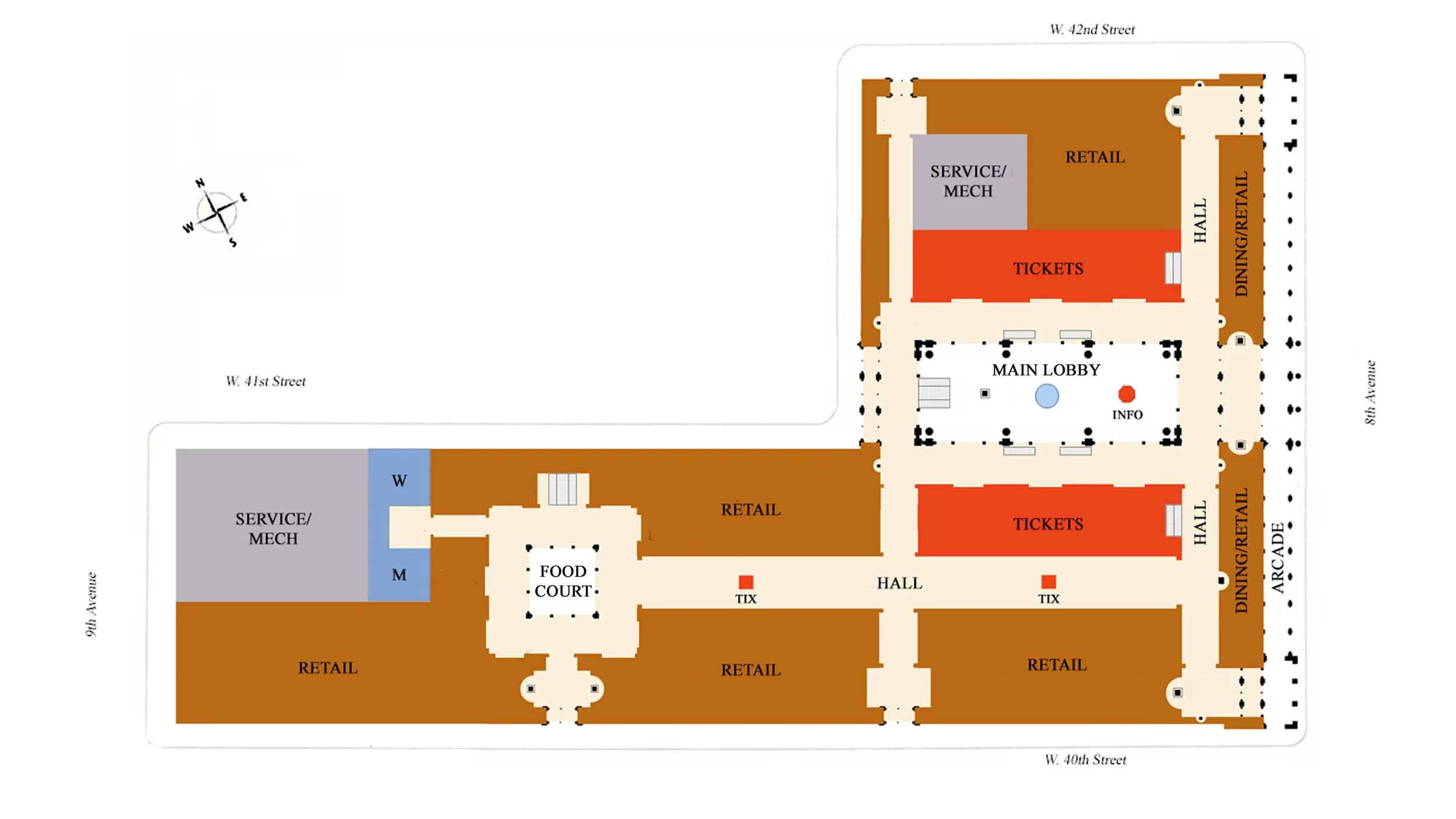
The exterior shell is an off-white sandstone and tan brick, materials and colors chosen to match nearby buildings in the Garment District. Sidewalks in the arcade will be large format slate, similar to much of historic downtown New York City. Permanent building materials are utilized to ensure the building lasts at least for the next 250 years of our nation’s history and to provide a feeling of stability to the public.
Bronze fretwork is used as the building’s jewelry in the large open arches of the bus gates. This material is used all throughout this design, including at storefronts, windows, and doors. It is utilized in public art too, along with stone, especially for the sculptures located throughout the interior of the building in niches. The actual structure of the building is steel and concrete in order to best accommodate heavy bus traffic. All visible building materials will be human scale so the public will be able to relate to the building and feel embraced.
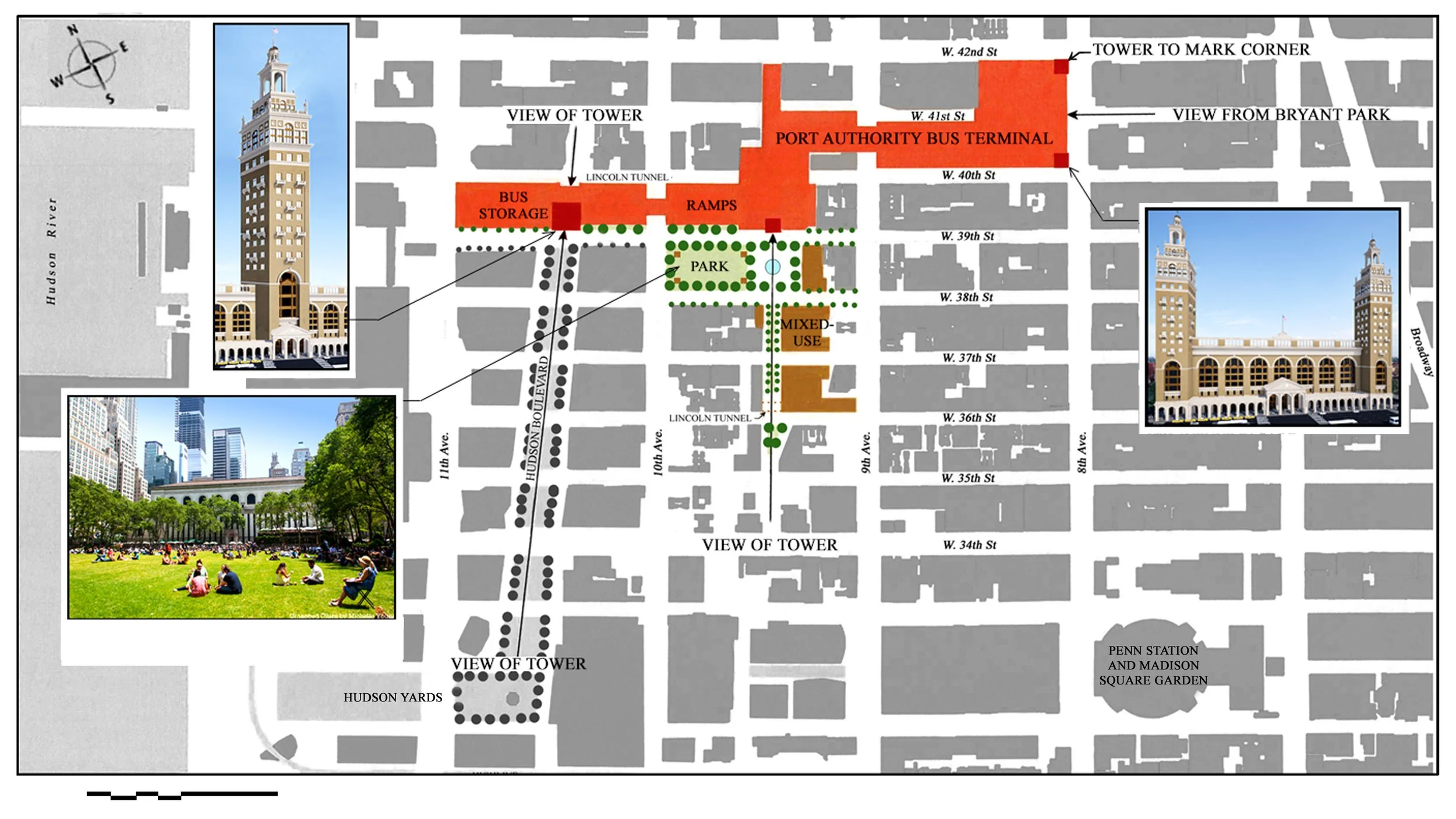
A gracious public park is provided, serving both the city and the bus terminal, similar in design to Bryant Park. Filled with grass, trees, and cafe/bar pavilions, the park provides a place to rest from the commotion of the big city streets. Built over the existing ramps south of the terminal, the park makes use of available real estate to give the community a desirable amenity. Users of the bus terminal will have access to the secondary lobby from the park. The bus terminal’s architecture will rest on the park, which is a proper and dignified setting for a public building. The public will thus be able to behold the edifice be inspired and uplifted.
All building footprints throughout the site design engage the sidewalk to provide delight, safety, and economic vitality on the street. It can be anticipated that New Yorkers and visitors alike will be delighted with and be grateful for the gracious new urban conditions and the strikingly beautiful and grand classical architecture.
The new bus terminal is designed utilizing traditional architectural principles. The chosen building materials of brick and stone are traditional in that they come from nature and have immediately graspable limitations, allowing humans to relate to them. The use of historical precedent in design inspiration creates a continuity with history and allows the building to be legible within the greater context of the city. Classical orders, a trademark of traditional architecture, and their accompanying moldings are employed throughout the design, most notably at the street level and in the towers.
A traditional principle of design is dividing buildings into a base, middle, and top, to correspond to the human form, which is organized into base (feet), middle (body), and top (head). The bus terminal facade is thus subdivided into a base (arcade), a middle (wall), and a top (entablature). The arcade is then subdivided into three parts, the base (pedestals), middle (columns), and top (entablature/pediment). Furthermore, at the street level, pedestals are divided into three parts, and so on. Individual molding groups are also subdivided into smaller parts, in an effort to achieve human scale. It is at the scale of the bus terminal’s street level moldings that humans will most palpably experience the breaking down of the scale of the building.